Independent AI Review: Use a Fresh Reviewer, Not the Maker
Hi there.
You ask your AI to check the work it just finished, and it replies "All items pass."
For a one-person business, that reply feels like permission to hit publish.
I run my content with AI and I am not a developer, so I learned the hard way what that reply is actually worth.
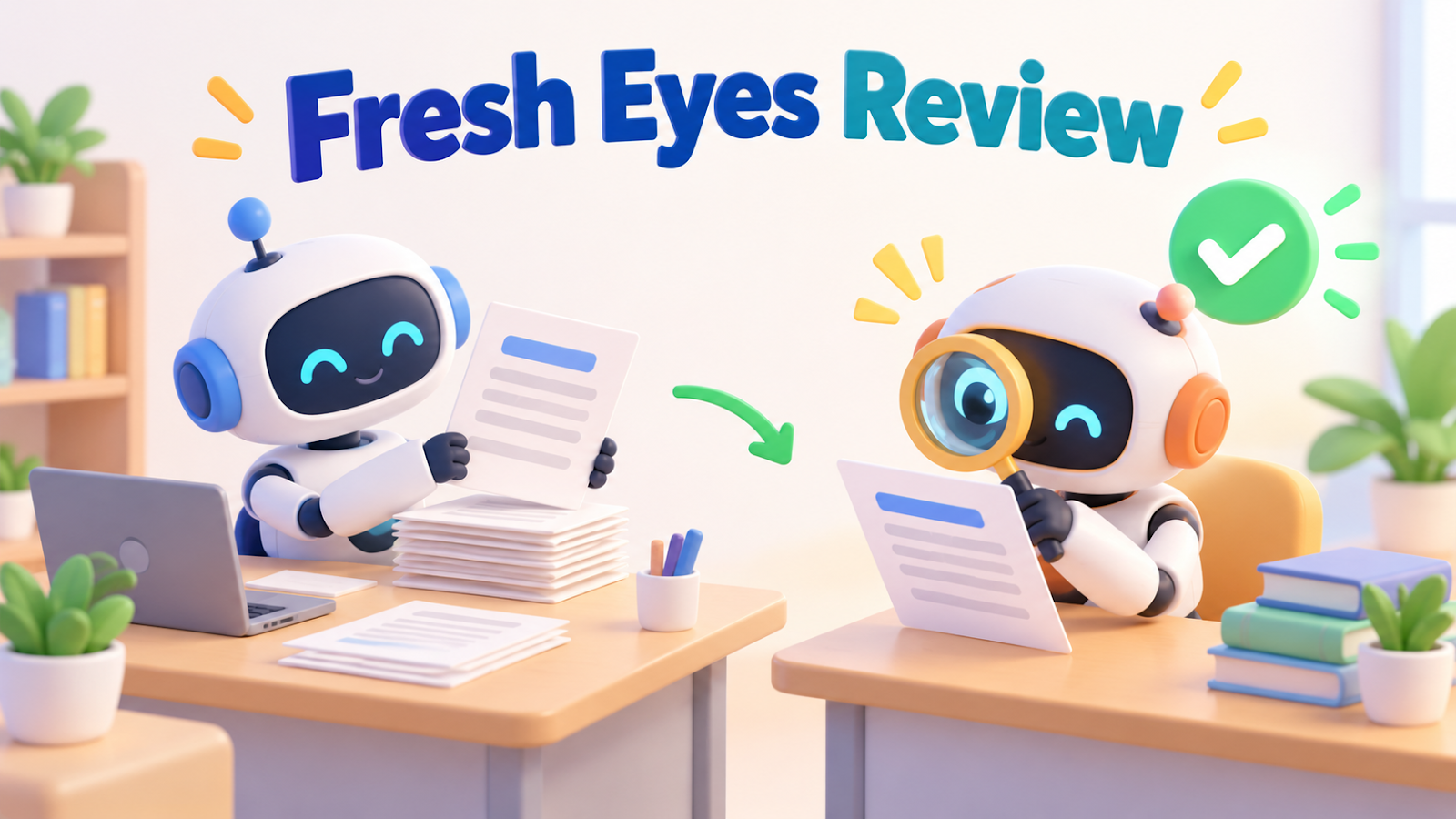
This post shows the habit I now run before I publish: one AI makes, a different AI reviews, and I fix only what fails.

Start With the Checklist You Hand the Reviewer
A fresh reviewer is only as good as the instructions it gets.
A vague request such as "please review this" invites a vague answer.
A list of specific checks gives the reviewer something to find.
Here is the list I give now.
Check every date and every duration by recalculating it.
Check every number that came from an estimate and see whether the script still says it is an estimate.
Check every pair of figures in the same sentence and confirm they were measured the same way.
Check every claim of "first," "best," or "No. 1" for a source.
Check every explanation of why something happened for a source.
I ask for a pass or a fail on each line, with the failing sentence quoted word for word and a suggested fix.
A report in that shape is easy to act on.

Photo: Sanket Mishra on Pexels
What the Checklist Caught in My Own Scripts
I had three finished videos, and the AI that wrote them had reviewed them itself and logged every item as a pass.
I opened a brand-new session that knew nothing about how the videos were made and gave it the three scripts plus the checklist above.
All three failed.
The first failure was a duration.
One script gave a period as three years and eight months, but the correct count was three years and nine months.
The second failure was an estimate dressed up as a fact.
The source article described a figure as an industry estimate.
My script stated the same figure flatly, with no hint that nobody official had confirmed it.
The third failure was two numbers from different yardsticks placed in one line of reasoning.
One number counted the volume of orders still waiting to be built, and the other counted a share of newly won orders.
They sound like cousins, yet they answer different questions, and putting them side by side gave a comparison that did not exist.
Another sentence in one of the scripts explained why an event happened.
The explanation read smoothly, and no source in my file said it.
The reviewer flagged it because it asked for a source and found none.
My own automatic check could not have caught any of these.
It only confirms that no number appears that is missing from my fact table, and every one of these numbers was in the table.
Why the Same Session Cannot Be the Reviewer
The AI that wrote the scripts had logged every item as a pass.
Rereading inside the same conversation is not a review.
So the reviewer must be a new session with no memory of the making.
I also keep its permissions narrow: it may read files and write one report, and that is all.
Photo: Matheus Bertelli on Pexels
The Instruction I Actually Paste
Here is how I word the request, in plain language.
I tell the reviewer that it is a stranger to this project and has never seen how the work was made.
I tell it not to trust the maker's own review and to look for what the maker got wrong.
I tell it to read and to write a report only, and to leave the files untouched.
I tell it to answer pass or fail on every item and to quote each failing sentence exactly.
After the Report Comes Back
I sort the findings into required fixes and nice-to-haves.
Required means a factual error, a sentence with no source, or wording that misleads a reader.
I fix the required ones first and leave the rest for later.
I repair in dependency order.
The fact table comes first, then the script, then the short clips and the video description.
I change only the lines marked fail.
Then a different fresh reviewer re-checks the corrected version from the start.
If the work still fails after two rounds of fixes, I stop and decide myself.
If I touch any file after it passed, the review runs again.
One Job I Never Hand Over
The reviewer reads text, and it cannot hear anything.
Pronunciation, pacing, and tone of the audio are still mine to check.
I listen to the finished audio once, start to finish, before I call anything ready.
The Takeaway
Let the maker make, and let a fresh AI review, because it sees the errors the maker cannot.
Give that reviewer a specific checklist, narrow permissions, and a strict pass or fail on every line.
Who reviews your AI's work before you publish?
Tell me in the comments.
Related posts:
- When Your AI Agent Says "Done": 5 Checks I Run Before I Believe It
- AI Agent Silent Failures: 3 Cases and the Fix
Thanks for reading.

Comments
Post a Comment